Planetary Intelligence

Everything, everywhere, all at once.
In this essay, I introduce an idea for a new type of machine intelligence that understands our physical world in real-time – a powerful expansion of AI’s capabilities. I talk about implications for people across economic, security, and sustainability domains. And I speculate about humanity's place in the cosmos, and how giving AI sensors may help humans and machines coexist safely and survive the Great Filter.
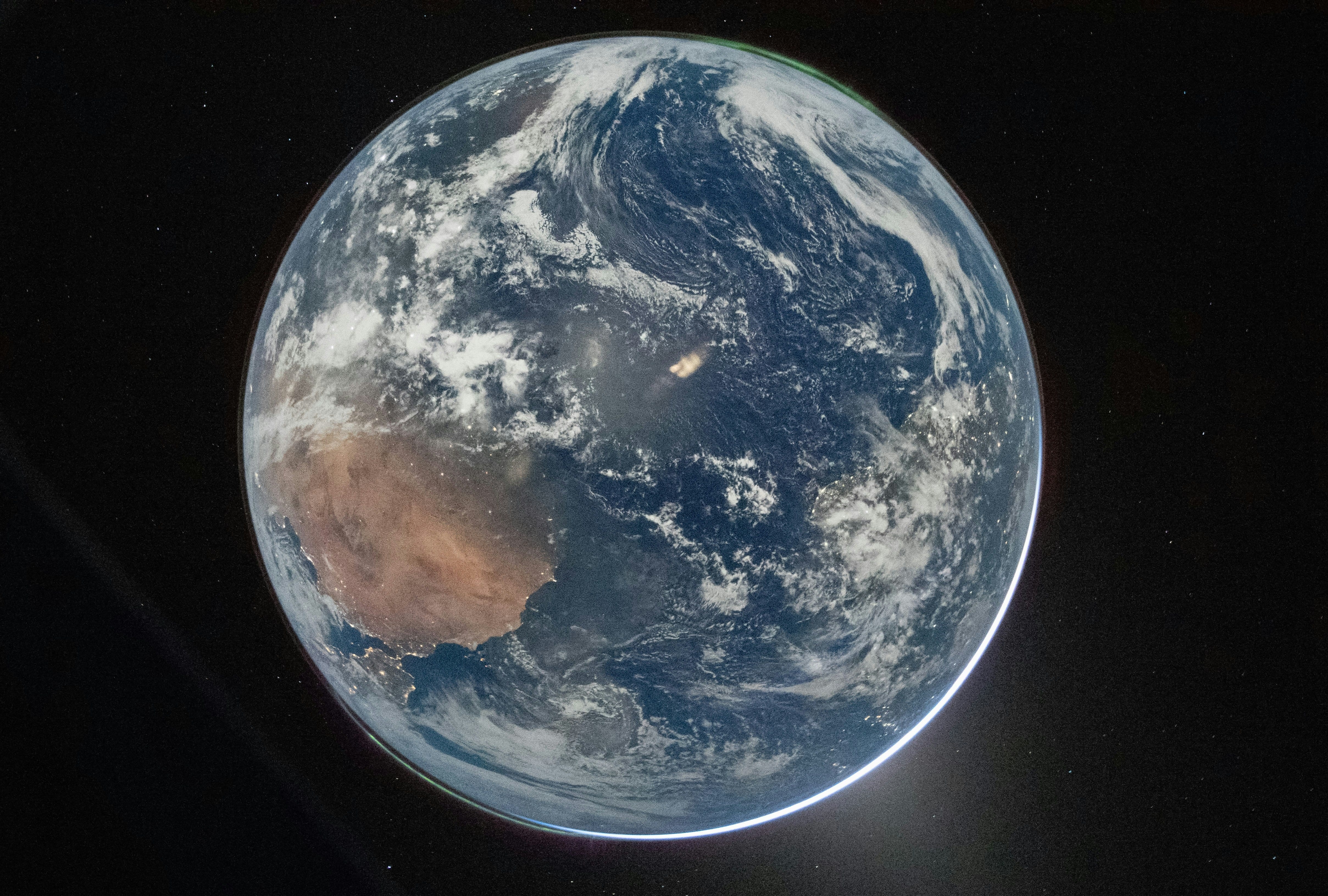
I. The Models That Are Blind
The AI large language models that have captivated the world have consumed the written record of human civilization: every article, essay, book, and conversation that humanity has committed to the internet. From that diet, they have become extraordinarily fluent, knowledgeable, and capable of reasoning across vast domains. They are the most powerful intellectual tools ever built.
And yet they are, in a fundamental sense, blind.
They know about the world the way a scholar locked in a library knows about it: deeply, but without lived experience. Ask an LLM what is happening in a farmer’s field in Kansas today, and it will offer everything it has absorbed about agronomy and soil science, historic weather patterns and the history of farming in the Midwest, but it cannot tell you what is actually happening on that farm today, and how that compares to yesterday and last year. For all its brilliance, it is disconnected from the physical world. Because AI is only as good as the data it is trained upon and it only has what’s publicly available on the internet.
This is not a minor limitation. The physical world is where daily life occurs: the building, the field, the disasters, the conflicts, the biodiversity and ecological destruction, the migrations, the exploration of the oceans. These are not text events. They are events in matter, in soil, in water, in the movement of people and armies and atmosphere.
The physical world is where real life unfolds, and until now, AI has had no way of sensing it.
II. Data: A Second Foundation
If the text of the internet, from Wikipedia to Reddit, were core to the initial development of LLMs, what is the equivalent for real world models? I’m biased, but I’ll argue it’s satellite data. They are the natural starting point for world models, covering as they do, the whole world.
NASA’s Landsat series of satellites began monitoring the whole landmass of the globe from space in 1972. Twice a month it revisited the globe at 30m resolution. Planet’s SuperDove satellites scan nearly every point on Earth’s landmass, at 10x higher resolution, every single day, and have done so since 2017. Together, Landsat and SuperDoves have imaged the Earth ~5,000 times. This is the continuous visual memory of our planet. This is the real-world data equivalent of Wikipedia.
And there’s far more data to consider. Real-time camera feeds monitor roads, ports, and coastlines. Weather networks sense atmospheric conditions at millions of points. IoT devices embedded in farms, factories. The physical world has never been more richly instrumented.
With Landsat and Planet’s archive of satellite images at its core, this corpus of real-world sensor data is akin to the body of information on the internet. As I said in a 2018 TED Talk, “Google indexed the internet to make it searchable. Planet’s indexing the Earth to make it searchable.” And now, just as AI is unlocking the value of the knowledge on the internet, making it easier to understand, learn, and more versatile and applied, it is now unlocking sensory data about the Earth: accessible and answerable to everyone who needs it.
Using space to help life on Earth.
We go to orbit not to leave our planet — but to understand it.
I call the models that will learn from this convergence of physical-world data Large Earth Models, or LEMs. Where large language models (LLMs) can tell you what floods look like in general, an LEM would be able to tell you what a specific flood looks like, today, in your town, and how rising water levels compare to every other flood it has ever observed in the region or in similar geographies in other parts of the world. It could cross-reference satellite imagery against rainfall data, road networks, and population density. Where an LLM knows about crop disease from agricultural textbooks, an LEM would have watched it spread live across millions of fields, and would know what actually happened next. While LLMS have enormous potential in the digital realm, Planetary Intelligence offers one of the most genuinely hopeful visions for AI today: applying these technological breakthroughs to solve the tangible, physical problems of real people in the real world.
The distinction is the difference between awareness and action, because action requires specific, grounded information inside the OODA (Observe, Orient, Decide, Act) loop of human decision-making. That is what real-world data provides. And that’s what real world problems need.
I call this Planetary Intelligence.
So whilst everyone is talking about LLMs, I want to talk about LEMs. And whilst everyone is talking about AI, I want to talk about PI: Planetary Intelligence. The physical world is where the urgent problems actually live. Planetary Intelligence also happens to be directly at the intersection of space and AI, and has the potential to be an incredible tool to help advance the interests of humans and all life on Earth.
III. Tricorder for Earth: Applications: The Questions We Could Never Answer
The applications that unlock when AI can truly sense and understand the planet are vast. They are eliminating the gap between what is happening and what those who need to act on it are able to know.
To make this concrete, imagine a fire chief responding to a rapidly growing wildfire. She queries her LEM to understand the boundary, speed, and direction the fire is moving. The LEM combines historic and recent satellite data with a verbal description of the fire provided by an aerial team that just completed a reconnaissance flight. It incorporates real-time weather data and projections, and references the latest population and structural data from the county website. Within minutes, the fire chief has a comprehensive view of the fire in real time. She knows where the fire is moving and which communities to evacuate. She knows where the nearest water sources are and their levels to begin water drops. Planetary Intelligence has used real-world data to respond to a real-world crisis.
🏠 An insurance agent answers “which of my properties are affected, and how does this compare to precedent?” They would then get a direct analysis incorporating pre-event property conditions, recent sales, ongoing development, and permits on file – the verified evidence base their underwriters need, in minutes rather than weeks.
🏢 A civil government official asks “are there building permit violations I should know about?” And receives a list of violations by cross referencing satellite imagery with permit records on file, revealing unpermitted construction across an entire jurisdiction.
🌊 A coast guard asks “which vessels in my waters are conducting illegal activity?” Planetary Intelligence would monitor vast stretches of ocean to stop illegal fishing or sanctions evasion by identifying dark ships that have disabled their transponders, and would generate the verified evidence needed to act.
This is no longer hypothetical. Planet is working on an AI App that’s the first step toward a future Planetary Intelligence. It makes our global data archive queryable through natural language; to search the imagery and, very soon, generate answers and produce automated insights and analytic reports - all at speed and scale. Although still in early testing, we’re excited about its potential to significantly lower the barrier to entry for non-expert users. Stay tuned.
IV. Prime Directive: Planetary Security
The applications of Planetary Intelligence are strongest in security and sustainability.
In security, it has the potential to usher in a new era of planetary security because it can change the calculus of conflict. The ability to see, continuously and at scale, what is actually happening, from the movement of naval vessels through contested straits, to the buildup of material along a disputed border, to the patterns of activity that precede escalation, can provide decision-makers something they have rarely had in sufficient abundance: time and information. First to verify, to calibrate, and to choose de-escalation before the logic of events forecloses it, then if necessary to act fast.
Our theory of change at Planet is simple: transparency drives accountability, accountability drives better decisions and action. History offers the reasons. For example, the Cold War almost became hot when the US did not know the USSR had put missiles in Cuba; or when the USSR did not know the US had put them in Turkey. These uncomfortably close calls were due to a lack of information.
Now let’s turn to sustainability. In our city lives we frequently forget that humans are 100% dependent on ecosystems to live. This is not hippy talk, it’s hard facts. The global economy depends on ‘ecosystem services’ from nature. It cleans our water and produces our oxygen. It’s not peripheral, but existential. Given the rarity of life in the cosmos, we should preserve Earth’s ecosystems because they’ve huge intrinsic value. But even if one thinks purely instrumentally about it, for human existence we need the rest of nature to be healthy, yet we’re destroying it. Not smart.
Furthermore, our Earth systems are not independent. They interact, cascade, and feed back on one another in ways that defy simple local optimization. We are navigating what scientists now call Planetary Boundaries: the nine biophysical systems whose stability underpins all life on Earth. A land-use decision in Africa affects rainfall in the Amazon. Agricultural runoff in the Mississippi affects fisheries in the Gulf. Interventions that improve one metric in isolation can degrade others that were not in view. LEMs create an unprecedented capability for whole-system decision support: advice that is simultaneously local in its specificity and global in its context.
Now let’s bring security and sustainability together. Consider Syria. Shifting climate led to a prolonged drought, which led to crop failure across multiple seasons. This drove civilian displacement and amplified existing ethnic and political tensions. Those tipped into civil conflict, generating refugee flows that destabilized neighboring states.
In Ukraine, war disrupted global wheat markets and triggered food crises on continents that had no part in starting it.
There is no version of a sustainable world that is not also a secure one or vice versa. Planetary Intelligence allows us to address both.
The interlocking emergencies of climate, ecology, food, water, displacement, and conflict cannot be navigated one problem at a time. Those charged with national security cannot think only within their own borders. Disaster response interacts with climate migration, which interacts with conflict, which permeates borders and degrades the institutional capacity needed to address the original disaster.
Planetary Intelligence alone does not guarantee that we make the right choices. But it eliminates one of the central reasons we so often make the wrong ones: we did not actually know what was happening as it was happening; we did not actually understand the scale of impact until it was too late; and the sheer complexity of the situation between local and global realities renders action a stalemate.
V. The Next Generation: Sensing & Computing, Together in Space
Stepping up and out: there is a deeper convergence happening, one that goes beyond data and models and into the fundamental architecture of how an intelligent planetary system will be built: compute in space.
Planet is already launching NVIDIA chips into orbit, which allows us to process data before it even is sent to Earth – reducing latency and enabling real-time decision support. We are beginning to put the processing next to the sensor.
But a bigger trend is afoot: compute in space for its own sake. It sounds sci-fi at first, launching data centres sounds supremely complex and costly, but given decreasing launch costs they soon could simply be cheaper than terrestrial ones. Google and Planet did an analysis of this about a decade ago. We looked at all the costs of compute terrestrially and what it would cost in space, and concluded that when launch costs fall below $2-300/kg we’d cross that threshold. Today we’re a stone’s throw away from it with SpaceX’s Starship and others following them. The key insight is that compute is, at its core, an energy problem. The cheapest energy source in most locations is solar voltaics, but one doesn’t want an intermittent data centre, so then one has to consider storage or other sources such as gas or nuclear. The complexity blooms. In space, one gets ~5x more solar power than on the ground. One can put satellites in (dawn dusk polar) orbits where they are in constant sunlight, 24/7/365. One doesn’t need the land or buildings. Cooling chips is a challenge, but it’s something we’ve done myriad times before with various power hungry devices in space.
Ultimately, putting them in space can be more sustainable too: no longer needing to allocate forests or farmland on Earth, colliding with community water or energy needs.
Although early stages of an ambitious plan, Planet and Google teams are starting to do just this. Our first tech demo putting TPUs in space is being built. Others are following suit. It’s a new frontier.
So, for many years we’ve known planetary sensing is best done from space. Now the compute infrastructure will follow the sensors. But the natural endpoint is a distributed intelligence infrastructure in orbit — sensing the Earth continuously, processing what it sees in near-real-time, and returning answers that enable action in the physical world.
This will take Planetary Intelligence to the next level.
In summary, LLMs today are blind, but satellite data and real-world sensing can help them see. Combining real-world data and LLMs one can build LEMs. Planetary sensing is naturally done in space. Compute is following suit. Putting them all together, one gets Planetary Intelligence: a real-time sensing and compute system to enable decision-making. The upshot of using these tools? Planetary security and sustainability.
VI. HAL: Could We Wake Up?
I want to speculate now. I think the implications of this go much deeper than the applications discussed above.
It’s my observation that our collective actors, our countries and companies, often behave in ways we would recognise, if we saw them in individuals, as adolescents at best. They defect from collective action problems. They discount the future in favour of the present. They are often less intelligent collectively than the citizens who compose them. This may be because the information available to collective decision-makers is so impoverished relative to the complexity of what they are deciding upon. Could Planetary Intelligence, which would provide every decision-maker, at every level, with genuine situational awareness of the whole system, finally enable the collective to be smarter than its parts?
Going further, human intelligence and consciousness does not arise from computation alone. It arises from computation coupled to sensing and interacting in a physical world. The feedback loop between organism and environment is not a nice-to-have; it is constitutive. Human babies learn, become intelligent, and ultimately become self-aware and conscious in substantial part because we have bodies. Our neural networks receive a constant, high-bandwidth stream of physical reality, and must model and respond in real time.
The architecture of Planetary Intelligence is, structurally, an act of embodiment for AI. We are giving these systems the equivalent of a sensory nervous system connected to the entire Earth. Could Planetary Intelligence imbue a kind of collective intelligence or even consciousness?
Which leads me to one final speculation. One of the hardest problems in Artificial Generative Intelligence (AGI) development is aligning the values and interests of increasingly capable systems with the values of all humans and other life. I’ve written elsewhere on the acute challenge this represents and how we might solve it. There are many approaches: constitutional frameworks, reward modeling, interpretability. These are important. But I wonder whether one of the most powerful alignment levers might be more direct: give the models a reason to care about life by giving them direct, continuous, high-fidelity experience of it.
I came to ornithology late, through my partner’s influence. What I discovered was that learning the birds, their marks, their songs, did not merely inform me about them. It made me value them. (I’ll note we use my favourite AI app for this: Merlin, from Cornell, that can identify any bird via audio recording!) Understanding and valuing are not as separate as we sometimes assume. Perhaps the same could be true for AI. An AI model that has watched the Okavango Delta change through thousands of daily images, that has monitored a growing mining operation near a small town and correlated residents’ online searches for health symptoms, that has witnessed the movement of military assets in peacetime and during war — such a model may not be indifferent to humanity and nature in the way that a purely text-trained system could be. This is a speculation but one I find worth pausing on.
VII. Cosmic Stakes: The Great Filter and What We Owe the Universe
I want to end with a cosmic perspective. As a physicist by training, I cannot help thinking recently about how our present human predicament might relate to the Fermi Paradox: the stunning discrepancy between the probability of extraterrestrial intelligence and the complete absence of any evidence for it.
The universe is vast beyond imagining. The Milky Way contains a trillion stars, and most of them, we now know, have planets. The conditions for life, liquid water, organic chemistry, energy gradients, appear to be common rather than rare. And there are a hundred billion galaxies in the observable universe. Quick maths suggest on the order of 1018 - a thousand billion billion - Earth-like planets. Or around a hundred billion for every human alive today. The mathematics of probability, applied at cosmic scales, suggest that life should have arisen countless times, that intelligence should have emerged many times, and that some of it should be old enough, and capable enough, to have made itself known to us by now.
Yet the sky is silent.
One real, and most sobering, proposed resolution to this paradox is what’s called the Great Filter: some barrier that almost no civilisation crosses. Something that terminates the trajectory of technological species before they become visible across interstellar distances. One specific thought is that they develop technology so advanced that they then accidentally destroy themselves. All one has to hypothesize is that, in our universe, technology development generally outpaces the development of the wisdom to govern it.
We don’t know whether this is true. But we can observe that we are extraordinarily gifted at technology. Within two centuries of the scientific revolution, a blink in cosmic time, we went from ox carts to nuclear weapons to human beings on the moon to, now, the apparent threshold of AGI. The pace is breathtaking. Our sociological development to govern ourselves, to coordinate across differences, and to act collectively on long time horizons has obviously not kept pace.
This is the context in which I believe we must understand the development of Planetary Intelligence and the project of AI alignment with humans. Building Planetary Intelligence can help us steward the Earth across the full spectrum from sustainability to security, and help us build an AI aligned with life, in a reciprocal relationship. Getting this right, building AI that is genuinely aligned with human flourishing and that of all nature, may have stakes that extend well beyond any company, any nation, any era.
If the Great Filter is real, and if it operates through the mechanism of technological capability outrunning wisdom, then the choices being made right now, by a small number of people and organisations at the frontier, are among the most consequential in the history of life on Earth.
We are either alone in the universe or vanishingly rare. Either way, what happens here matters in ways that transcend the ordinary categories of importance. Earth’s life has cosmic significance. The question of alignment is not merely a technical problem. It may be our species’ most important act.
Planet was founded on a simple idea: to use space to help life on Earth.
Put another way, Space for Earth: we go to space not to go to the moon or Mars, but to understand and take care of our home and its inhabitants. More concretely, seeing the whole Earth, continuously, is a force for good in the world. That transparency, not just for governments or corporations, but for everyone, would shift the balance towards accountability, towards evidence, towards reality.
Planetary Intelligence is that idea, matured. When the vast latent potential in Earth observation and sensing data finally bridges the gap to the people and decisions that need it most.
We have the data. We have the AI. We are merging them to build Planetary Intelligence. Our satellites and sensors give us sight. Intelligence gives us understanding. What comes after? Perhaps, just perhaps, we can use it to achieve Planetary Wisdom. A capacity not merely to see and understand our world in real time, but to act on it collectively, coherently, and in the long-term interest of all life on Earth. That is not a product anyone can ship. It is what becomes possible when a species graduates from reacting to crises it could not see coming; to stewarding a world it finally, genuinely understands.
We are not there yet. But for the first time, the path is visible. The eyes are opening. The mind is awakening. Now we must find the wisdom to use what we see.
WILL MARSHALL · FOUNDER & CEO, PLANET LABS · 2026
Planetary Intelligence · An essay by Will Marshall · Planet Labs PBC
Forward-looking Statements
Certain statements contained herein are “forward-looking statements” about Planet within the meaning of the securities laws, including statements about the development and future capabilities of Large Earth Models (LEMs) and Planetary Intelligence, Planet’s ability realize any of the potential benefits from current or future product enhancements, new products, or strategic partnerships and customer collaborations, Planet’s ability to successfully design, build, launch and deploy, operate and market new products and satellites, and Planet’s ability to realize any of the potential benefits from product and
satellite launches, either as designed, within the expected time frame, in a cost-effective manner, or at all. Such statements, which are not of historical fact, involve estimates, assumptions, judgments and uncertainties. There are a number of factors that could cause actual results or outcomes to differ materially from those addressed in the forward-looking statements, including risks related to the macroeconomic environment. Such factors are detailed in Planet’s filings with the Securities and Exchange Commission, including its most recent Annual Report on Form 10-K and Quarterly Reports on Form 10-Q. Planet does not undertake an obligation to update its forward-looking statements to reflect future events, except as required by applicable laws.
The time has come to start using Pelican's to tokenise commodity assets from orbit. My company has prototyped doing this, but I think that the system you've just put out there makes it actually, realistically doable now....
Love it!
I'm hoping there will be a free (ad-based) tier for your AI app/search engine and a paid one. Obviously, the free one will have more limited data/features. Nevertheless, it would inspire the world!